April 3, 2026
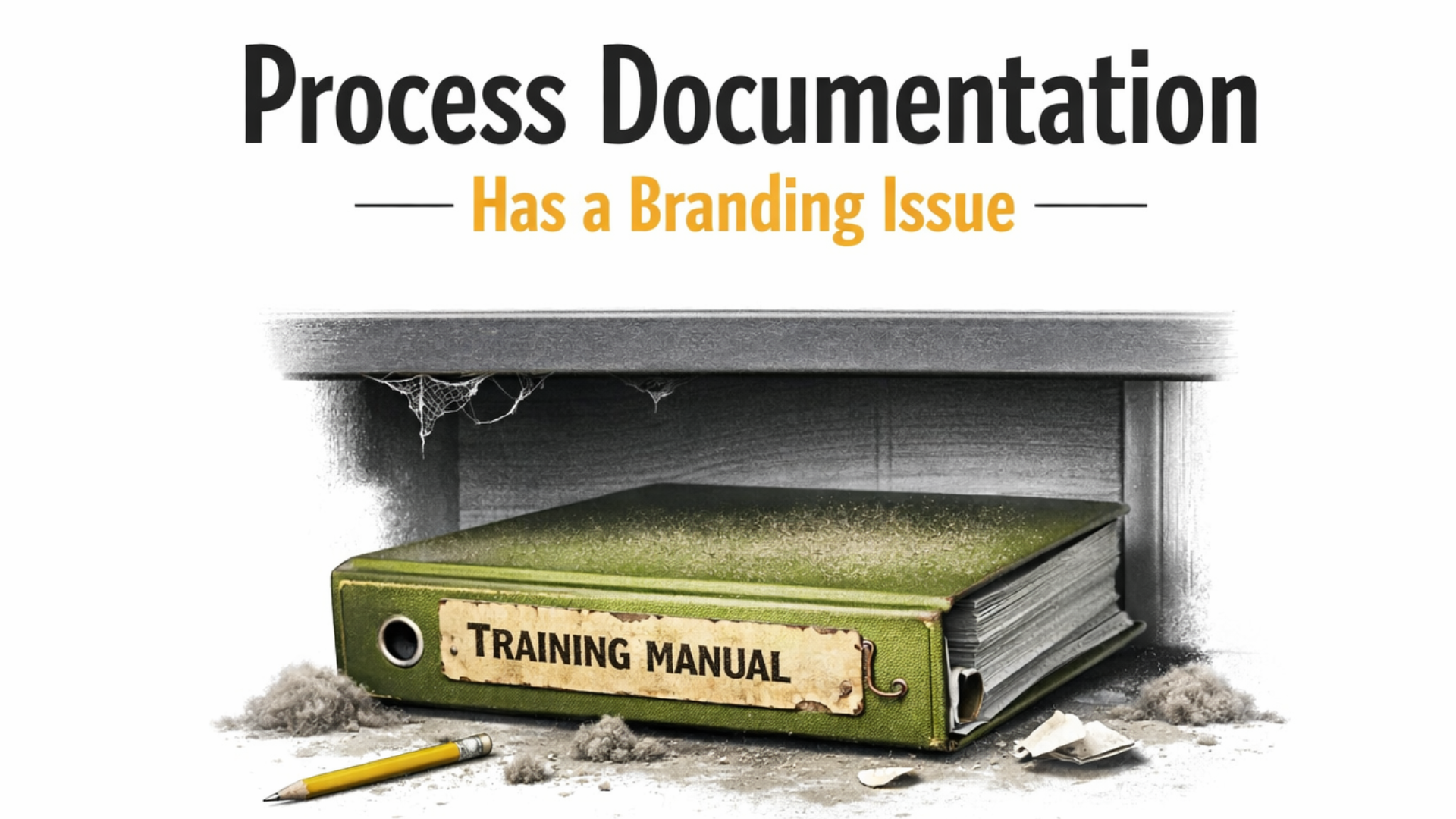
When most people hear “document the process,” they picture a dusty binder, a compliance exercise, or a tedious project that gets started, abandoned, and quietly forgotten. But when you work with me at Henderberg Business Solutions, process documentation is not paperwork, it’s a practical, high-leverage way to reduce stress, protect continuity, and scale execution without burning out your best people.
I’m going to summarize three top “value-add” benefits of process documentation that show up again and again when clients commit to doing this work the right way:
- Employees enjoy their jobs more because they know how to do a good job.
- Owners feel secure because the business isn’t one resignation away from chaos.
- Onboarding gets faster because managers stop being the training system.
If your company is hiring quickly, expanding to new locations, integrating after a merger, or simply tired of inconsistent execution, these benefits aren’t abstract. They’re the difference between feeling in control and feeling like the business owns you.
Why documentation is the “foundation,” not the finish line
Before we jump into the three benefits, here’s the core idea that guides my approach: nearly every business problem is a process problem in disguise. When something feels frustrating, slow, inconsistent, or dependent on one person’s memory, it usually comes down to one of three things:
You don’t have a process in place.
Someone isn’t following a documented process.
You’re following a process that’s outdated.
So when we document processes together, the goal isn’t perfection. The goal is clarity you can actually use. Usable documentation becomes a shared standard for training, accountability, quality control, and continuous improvement. It helps teams “trust the process” instead of living in constant improvisation.
Now, let’s get into the value-add wins.
1) Employee job satisfaction improves when people know how to do a good job
A lot of leaders think employee satisfaction is mostly about morale, perks, or motivation. Those things matter, but the fastest way to improve satisfaction is surprisingly simple: remove guesswork.
Most employees want to do good work. What they don’t want is to feel like they’re taking a test where the answers keep changing. In many organizations, especially fast-growing ones, that’s exactly what work feels like. Training is inconsistent. Instructions vary depending on who you ask. Best practices live inside someone’s head. The employee tries their best, but they’re never sure if they’re doing it “the right way” until someone corrects them, often after the fact.
That uncertainty is exhausting. It creates a quiet anxiety tax that shows up as hesitation, rework, and disengagement.
Good process documentation changes the daily emotional experience of work because it makes success visible. It tells employees what “good” looks like and how to deliver it. It answers questions employees are already asking (even if they’re not saying them out loud): What is the purpose of this task? Where does it start and end? Which tool or template is the right one? What steps are non-negotiable? What do we do when something goes wrong? When do I escalate, and to whom?
When those answers exist in a clear SOP or playbook, employees gain confidence quickly. Confidence leads to competence. Competence leads to pride. And pride is a major driver of satisfaction, because nobody enjoys feeling lost.
Documentation also reduces conflict between team members and departments. Many workplace “people problems” are actually handoff problems. Sales promises something Operations can’t deliver. Admin assumes Finance will catch something. A customer request bounces between teams because ownership is unclear. The employee stuck in the middle gets frustrated, and the business gets inconsistent results.
When we document processes properly, we clarify ownership and handoffs. We define what “complete” looks like when work moves from one role to another. That reduces friction, prevents blame cycles, and creates a calmer environment where employees can focus on doing work instead of navigating confusion.
One more underappreciated satisfaction boost: documentation honors your best people. Your high performers often become the “human instruction manual.” They’re proud to be trusted, but they also get trapped, constantly interrupted with questions, constantly training others, constantly carrying critical knowledge alone. Documentation captures their expertise and converts it into a company asset. That relieves pressure, enables growth, and helps retain the people you can least afford to lose.
When employees know how to do a good job and have the tools and clarity to prove it, job satisfaction improves in a very practical way: the workday feels winnable.
2) Owner security increases because your business isn’t one resignation away from chaos
Every owner has at least one role—or one person, who makes them a little nervous. Not because the person is bad, but because the business would suffer if they disappeared unexpectedly.
That’s key-person dependency. It’s one of the most common threats to stability in small and mid-sized businesses, and it hides in plain sight. It looks like “experience.” It feels like “loyalty.” But underneath, it’s a single point of failure.
When a key employee leaves with short notice (or even just takes an unplanned absence), businesses without documentation typically scramble in the same predictable ways. They hunt for passwords. They search for files. They guess which version is current. They recreate work because nobody knows the steps. Customers get delayed responses. Leadership gets pulled into emergency mode.
And emergency mode is expensive. It steals leadership attention from growth and forces the company to react instead of operate.
Process documentation is how you replace fragility with resilience. When core workflows are documented—along with the tools, access points, decision rules, and exceptions—the business becomes less dependent on memory and more dependent on systems. Work becomes transferable. Cross-training becomes realistic. Promoting someone no longer feels like pulling the last Jenga block.
Owner security also improves because delegation becomes possible without constant rework. Many owners want to delegate but keep taking tasks back. Usually, that isn’t because employees can’t handle responsibility. It’s because the “right way” exists only in someone’s head, so the work can’t be handed off cleanly. Without a clear standard, delegation turns into interpretation—and interpretation turns into inconsistency.
Documentation creates the standard. Instead of “do it how I do it,” it becomes “do it the documented way.” That shift reduces emotional tension, improves accountability, and makes delegation stick.
This matters even more for organizations experiencing rapid hiring, multi-location expansion, mergers, or inconsistent best practices—exactly the environments where operational stress is highest. In those situations, documentation is not an extra project. It’s operational insurance that also improves day-to-day performance.
The result is a specific kind of confidence: the business can withstand normal human unpredictability without panic.
3) Onboarding time savings happen because managers stop being the training system
Onboarding is where growing companies quietly burn money not because onboarding is optional, but because onboarding is often inefficient.
In businesses without documentation, onboarding usually depends on managers (or senior staff) repeating the same explanations over and over. The new hire shadows someone, picks up part of the workflow, and then starts working while still guessing. The manager corrects mistakes later. The new hire asks more questions. The manager pauses their own priorities again. Progress happens, but it’s slower and more expensive than it needs to be.
Here’s the hidden cost: manager interruption hours. Managers are among your most expensive resources, and their highest-value work is rarely “repeat basic steps for the tenth time.” Their value is coaching, decision-making, improvement, leadership, and handling true exceptions. When your onboarding system requires managers to be full-time trainers, your company pays twice: once for the new hire’s learning curve, and again for the manager’s lost productivity.
Documentation changes onboarding from manager-dependent to system-supported.
When core tasks are documented in a usable playbook, new hires can learn repeatable steps consistently. They can reference instructions without waiting for someone’s availability. They can self-correct faster. That doesn’t eliminate the manager’s role; it elevates it. Managers stop being narrators of basic procedure and become coaches who focus on judgment, quality, and performance.
A documented onboarding path also reduces variance. In many companies, onboarding quality depends on who is training that week. With a playbook, onboarding has a consistent baseline. That consistency reduces early mistakes, rework, and frustration on both sides. It also improves retention, because employees are less likely to feel lost or embarrassed in the first few weeks, the window when many early departures happen.
And if you’re hiring frequently, expanding locations, or integrating teams, documentation becomes a scaling tool. You cannot scale “watch me do it” training without exhausting leadership. You can scale a playbook.
The compounding payoff: satisfaction + security + speed
Each of these benefits is valuable on its own. Together, they multiply.
When employees have clarity, they perform better and stay longer. When the business isn’t dependent on one person’s memory, leaders can plan instead of react. When onboarding is system-supported, managers get their time back to build the company rather than pause it.
That’s why I keep bringing everything back to systems. Process documentation isn’t glamorous, but it’s foundational. It’s the clarity layer that makes training effective, execution consistent, and growth calmer.
Or, to put it in plain language: if clarity exists, scale it. If confusion exists, document it. If stress exists, simplify